

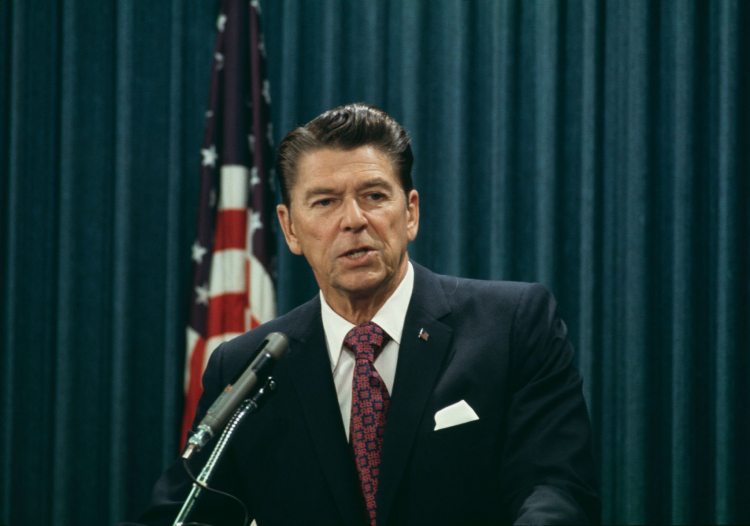
A Hollywood treatment of real-life events, “The Brink of War” gets off to an inauspicious start. The Cold War was “at its most critical point” in October 1986, reads the opening prologue card—yet one could assert that about basically any month from 1945–1991. President Ronald Reagan had announced the Strategic Defense Initiative (SDI) in March 1983. Yet, Soviet objections to it surely fell short of the broadside: “The Soviet military pledges to attack before the shield can be developed.” Indeed, President Ronald Reagan and General Secretary Mikhail Gorbachev had agreed in Geneva in November 1985: “a nuclear war cannot be won and must never be fought.”
The United States and Soviet Union were not on the brink of war eleven months later, when the two men faced off in Reykjavik for a “non-summit” that Gorbachev had proposed as an informal meeting with less pomp and circumstance than the 1985 Geneva Summit.
Cut to the Icelandic shore the early evening of Sunday, October 12, as Reagan vents his spleen to Secretary of State George Shultz about Gorbachev’s refusal to budge on the president’s sacrificing SDI to accept the elimination of all nuclear weapons. And then, thirty hours earlier, to the commencement of the action inside Höfði House. Between policy briefings and negotiating rounds devoted to missile throw weight and bomber counting discounts, “The Brink of War” provides human asides, including the proxy melodrama between Raisa Gorbachev, who accompanied her husband to Reykjavik, mugged for the cameras, and threw shade at her American counterpart. At the same time, Nancy Reagan remained in D.C. and seethed. Moderately effective are the scenes between the CIA and KGB officers learning to co-exist in close quarters in the basement in Höfði House. Less so are those featuring apparent flirtations between an NPR Reporter and a British journalist.
Everything gets better once Reagan and Gorbachev sit across from each other in the room. Director Michael Russell Gunn takes some creative liberties, to be sure. “Tear down this wall between us,” Reagan exhorts Gorbachev, paraphrasing his famous line in front of the Berlin Wall (in 1987). Banished are the stalwart interpreters Pavel Palazhchenko and Dimitry Zarechnak—in the movie, Gorbachev and Reagan speak directly to each other (in English). Soviet Foreign Minister Eduard Shevardnadze comes across as more of a hard-lined foil to Gorbachev than he actually was. The movie’s selective portrayal of the U.S. delegation tees up Reagan’s bemoaning that his negotiators were all Democrats. (“I’m a Republican,” Head of the Arms Control and Disarmament Agency Ken Adelman reminds him. So were National Security Advisor John Poindexter and White House Chief of Staff Don Regan, both of whom loomed large at Reykjavik yet are spent here.) Unfortunately, there is no reference to Assistant Secretary of State for European and Canadian Affairs Rozanne Ridgway, who from 8 p.m. until 4 a.m. that Saturday night led the U.S. negotiating team on all matters besides nuclear weapons.
Yet in sum, Gunn has clearly studied the historical record and crafted a serious movie that captures the gist of Reagan and Gorbachev’s exchanges and the ideas that underpinned them. Their final meeting—in two parts in the afternoon and early evening of October 12—lasted two hours and forty-five minutes, which is longer than the entirety of “The Brink of War.” Historians owe a debt to notetakers such as Deputy Assistant Secretary of State Tom Simons, who scrupulously recorded what happened that weekend. Moviegoers prefer a good narrative.
In the age of Generative AI, it is possible to transform the memorandum of conversation that Simons and others prepared into a movie. Any such film based solely on that would leave out the context for how Reagan and Gorbachev arrived at that moment and the consequences of their weekend encounter. It would also leave out human actors, who better remind us that human beings grappled with the dread of nuclear war throughout the Cold War—as they do in this new nuclear age.
For his part, Gorbachev wanted to arrest the nuclear arms race to revive the Soviet domestic economy. “We can’t go on like this,” he confided in Raisa, upon entering the Kremlin in March 1985—and “The Brink of War” alludes to this in an early encounter between Mikhail and Raisa. SDI complicated his aspirations for Perestroika (“restructuring”) because it fed into the Soviets’ own military-industrial complex, which excelled at designing and building missiles and whose influence far exceeded that of any U.S. equivalent. Throughout the movie, Gorbachev (Jared Harris) cites public opinion in a way that leads Reagan (Jeff Daniels) to smirk—he, Reagan, faced the American people who decided whether to vote Republican or Democrat. The false direct comparison aside, Gorbachev was in a bind throughout the weekend in Reykjavik. The last Soviet reformer, Nikita Khrushchev, was ousted two years after backing down to the Americans during the Cuban Missile Crisis. Every other Soviet leader had died in office.
Meanwhile, Gunn gives Reagan, as president, the star turn that he, as actor, never got in Hollywood. Onscreen, the president delivers his stock lines about world communism—an “octopus stretching tentacles”—and zings Gorbachev about forcing his people “to worship the party.” Jeff Daniels does not look or sound much like Reagan. Yet he depicts a man firmly in command of the facts who is devoted to the extraordinary idea of eliminating nuclear weapons and building mutually assured defenses. Even as tempers flare, nothing he says to Gorbachev gets him off track.
Early in the movie, Reagan sits down with his negotiators, who are supposed to be briefing him. The president briefs them. Max Kampelman, Richard Perle, and Paul Nitze (along with the NSC’s Robert Linhard and State Department’s James Timbie, who are not depicted in the movie) had contributed in some capacity to the July 25, 1986, proposal that Reagan sent Gorbachev, establishing a blockbuster nuclear arms package in five-year phases to preserve and then reevaluate the 1972 Anti-Ballistic Missile (ABM) Treaty, including sharing the benefits of SDI with Soviet leaders “moving toward our common goal of the total elimination of nuclear weapons.” The movie could have better spelled out this sequence. Still, it makes clear that Reagan arrived at Reykjavik with a clear plan for what he wanted to achieve on nuclear reductions—persuading Gorbachev to accept “the deal of the century.”
It also makes clear that multiple priorities drove President Reagan. “Trust but verify” toward any nuclear agreement meant Gorbachev needed to take action on human rights. Allowing Mstislav Rostropovich’s sister to travel to the United States to visit him for his birthday would demonstrate the new Soviet leader’s sincerity. At the same time—and as a later scene between Reagan and Secretary of State George Shultz (J. K. Simmons) suggests—the president committed himself beyond incremental reforms to defeating communism as a way of life.
The weekend in Reykjavik leaves Reagan seemingly empty-handed. Fast forward to the December 1987 Intermediate-Range Nuclear Forces (INF) Treaty, which eliminated an entire class of nuclear weapons, and Rostropovich’s playing Bach after the Berlin Wall came down in November 1989.
Reykjavik hardly ended the Cold War—let alone the collapse of the Soviet Union, which was an unintended consequence of Gorbachev’s reforms. Whether the “deal of the century,” Reagan put forth the deal of the Cold War, reiterating not only what he had written Gorbachev but said publicly to the United Nations on September 22: a phased plan leading “to the ultimate elimination of nuclear weapons from the face of the Earth.” Not everyone took him seriously. In Reykjavik and elsewhere, Gorbachev did. So should we.
James Graham Wilson works on Soviet and National Security Policy volumes for the Foreign Relations of the United States series in the Office of the Historian at the Department of State. He is the author of America’s Cold Warrior: Paul Nitze and National Security from Roosevelt to Reagan (Ithaca: Cornell University Press, 2024) and The Triumph of Improvisation: Gorbachev’s Adaptability, Reagan’s Engagement, and the End of the Cold War (Ithaca: Cornell University Press, 2014).
The views expressed here do not necessarily reflect those of the U.S. government or the U.S. Department of State.